Braille and the Internet: How Websites Can Become More Accessible

The Importance of Accessible Websites for Braille Users

Web accessibility is a fundamental aspect of the digital age, particularly as it pertains to ensuring equal access for all users, including those with various disabilities. This inclusivity extends to individuals who rely on assistive technologies to access digital content. A critical category within this domain is the accessibility of websites for users who utilize Braille displays or readers. As the internet becomes an increasingly essential resource for everyday tasks, the need for accessible websites grows more urgent, underscoring the significance of ensuring that Braille users are not left behind.

For Braille users, the digital landscape presents a unique set of opportunities and challenges. Websites that fail to accommodate their needs can inadvertently create barriers that prevent access to crucial information and services. To foster a more inclusive online ecosystem, it is essential to understand how Braille technology works and what steps can be taken to enhance accessibility.

Understanding Braille Displays

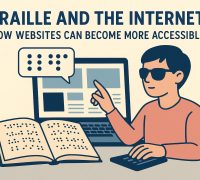
Braille displays are innovative devices that convert on-screen text into Braille characters. This transformation allows individuals who are blind or have severe vision impairments to access and read digital content independently. These displays typically function in tandem with computers, tablets, and smartphones, serving as both input and output devices for the user.

The operation of a Braille display involves a row of cells that raise and lower pins to form Braille characters. The user can navigate through text or control the device using a keyboard, enabling interaction with the digital world. Given this significant role in accessibility, ensuring that websites are compatible with Braille technology is an essential aspect of inclusive design.

Challenges Faced by Braille Users

Despite advancements in technology, Braille users still face numerous challenges when navigating the web. These obstacles often stem from the design and structure of websites. Some common issues include:

Non-Text Content: Many websites incorporate images, videos, and other multimedia elements that lack descriptive alt text. Without this descriptive text, Braille users cannot access the information conveyed through these non-text components, leaving gaps in their understanding of the content.

Complex Navigation: Websites with intricate layouts, elaborate menus, or non-linear navigation paths present significant challenges for Braille users. The complexity can make it difficult to locate and access desired information efficiently, leading to a frustrating and time-consuming browsing experience.

Missing Semantics: The misuse or absence of proper HTML tags can result in Braille devices misinterpreting the structure and content of a website. This misinterpretation can lead to confusion and difficulty in determining the hierarchy and importance of various elements on a page.

Making Websites More Accessible

Given the challenges faced by Braille users, website owners and developers must employ strategies to enhance accessibility. Implementing these strategies not only benefits users who rely on Braille but also improves the overall user experience for all visitors. Here are some effective methods:

Utilize Semantic HTML: Semantic HTML involves using markup elements that clearly convey the meaning and structure of a webpage. By organizing content with semantic HTML tags—such as <header>, <footer>, <nav>, <article>, <aside>, and more—developers can ensure that screen readers and Braille displays accurately interpret the content. Utilizing heading tags like <h1>, <h2>, etc., helps in establishing a clear content hierarchy, simplifying navigation for users.

Provide Alt Text for Images: Including descriptive alternative text for all images is crucial in making non-text content accessible. Alt text should succinctly describe the purpose and content of the image, providing context that Braille users can understand.

Ensure Keyboard Accessibility: Many Braille users rely on keyboard navigation to browse websites. Therefore, it is essential for websites to support keyboard-based interactions. Developers should test websites to ensure that all interactive elements, such as forms, links, and buttons, are reachable and usable via keyboard commands alone.

Implement Robust ARIA (Accessible Rich Internet Applications): ARIA roles and properties can improve accessibility by providing additional context to assistive technologies. Proper use of ARIA can help clarify the function of widgets and enhance the user’s ability to interact with dynamic content.

Consistent Use of CSS for Visual Elements: Styling should be separated from content to avoid confusing Braille readers. By consistently applying CSS*, developers can maintain a clear separation between appearance and functionality.

Regularly Test with Assistive Technologies: Engaging individuals who use assistive technologies in user testing can provide valuable insights into potential accessibility issues. Developers should test websites with screen readers and Braille displays to identify and rectify any obstacles.

Resources for Further Learning

To deepen their understanding of web accessibility and Braille integration, web developers and content creators are encouraged to consult the comprehensive Web Content Accessibility Guidelines (WCAG). The WCAG offers in-depth guidance on how to enhance web accessibility, outlining best practices and success criteria that ensure a more inclusive online environment for everyone. By adhering to these guidelines, developers can contribute to a digital landscape that is accessible to all individuals, regardless of their abilities.

Ultimately, creating an accessible web benefits everyone. It enhances the user experience, expands the audience reach, and fulfills ethical responsibilities of inclusivity. As the digital world continues to evolve, prioritizing accessibility will remain a key consideration in designing equitable and user-friendly web experiences.

The Impact of Braille Literacy on Employment Opportunities

The Importance of Braille Literacy

Ensuring literacy in Braille is crucial for enhancing the employment opportunities available to individuals who are blind or visually impaired. By understanding Braille, individuals are granted greater independence and the ability to engage with a broad array of information. This literacy fundamentally enhances their capacity to explore varied job opportunities and fosters a more inclusive workforce.

Understanding Braille

Braille, essentially a tactile writing system, serves as a pivotal medium for those with visual impairments to engage in reading and writing. Comprising different configurations of raised dots, Braille encodes letters, numbers, and various punctuation marks. Its existence is not merely functional but transformative, enabling users to achieve literacy in reading and writing—skills deemed essential for active workforce participation.

In delving deeper, learning Braille provides more than just a basic form of communication. It cultivates an enriched skill set that goes beyond the apparent. Users are not merely deciphering patterns—they are embracing an entire system that molds their cognitive abilities, allowing for an enhanced understanding of their surroundings and more nuanced interactions with written material.

The Connection Between Literacy and Employment

A substantial body of research highlights a compelling correlation between Braille literacy and employment prospects among visually impaired individuals. Those skilled in Braille often demonstrate superior job performance, stemming from their capacity to navigate job-related tasks efficiently. With access to a wider array of job roles, proficiency in Braille directly correlates with strong communication abilities, heightened productivity levels, and elevated independence.

Braille literacy effectively serves as a bridge to a multitude of professional avenues, broadening the horizon of career options. Whether in customer service, information technology, or administrative roles, the ability to read and process information independently empowers these individuals, allowing for seamless integration into diverse job markets. This proficiency not only aids employment placement but also enhances job security and career progression opportunities, ensuring a sustained professional journey.

Advantages of Braille Proficiency in the Workplace

In workplace environments, individuals proficient in Braille often exhibit a remarkable degree of adaptability. The ability to autonomously read printed materials, complete forms, and engage in written correspondence removes the need for constant external assistance. Consequently, such individuals are perceived as self-reliant by both employers and colleagues, which can, in turn, lead to increased job responsibilities and potential opportunities for career advancement.

Moreover, possessing strong Braille skills translates to improved problem-solving capabilities and a more effective engagement with a variety of workplace scenarios. This level of proficiency enables visually impaired individuals to compete on equal footing with their sighted counterparts, reinforcing the meritocratic principles upon which most professional environments are built.

Legal Support and Resources for Braille Education

The push for Braille literacy is bolstered by several supportive organizations and legal frameworks. For instance, the Individuals with Disabilities Education Act (IDEA) mandates the consideration of Braille instruction for visually impaired students as a component of their individualized education programs. This legislative backbone ensures that the educational needs of individuals are met, accelerating their journey toward literacy.

Numerous organizations, such as the National Federation of the Blind, extend resources and support systems for those eager to master Braille. These resources, whether sourced from formal institutions or community-based initiatives, play a pivotal role in an individual’s capability to secure meaningful employment. Such opportunities for education and support dramatically enhance the prospects for economic independence and personal growth in visually impaired individuals.

The availability of these resources, therefore, cannot be understated. They offer a gateway to knowledge and opportunities, serving as catalysts for individual empowerment and societal integration. Whether accessed through educational channels, technology-driven platforms, or community outreach initiatives, these resources embody the commitment to fostering an inclusive society where everyone has the chance to thrive.

Conclusion

In the burgeoning digital age, Braille literacy continues to stand as an indispensable tool for individuals who are visually impaired. It enables them to remain competitive within the job market, facilitating not just employment but empowerment. By acquiring proficiency in Braille, individuals open the door to enhanced career prospects and significant strides toward economic independence.

The persistent and collective support for Braille education and literacy initiatives is critical. These efforts not only uplift those directly impacted but also contribute to a more inclusive society, demonstrating that barriers can be overcome through informed, collaborative action. By prioritizing Braille literacy, we ensure that individuals within the visually impaired community have equal access to the opportunities they deserve, fostering a more equitable workforce and, ultimately, a more inclusive world.

The Science Behind How Braille is Perceived by Touch

The Basics of Braille

Braille is a tactile writing system invaluable to individuals who are visually impaired. The system utilizes a sequence of raised dots that are organized strategically to represent alphabetic letters, numeric symbols, and various punctuation marks. Developed by Louis Braille in the early 19th century, this innovative system remains a cornerstone for literacy and facilitates effective communication among those with visual impairments. Braille allows individuals to engage with the written word in a manner that is both functional and empowering, bridging a significant gap in the accessibility of information.

How Touch Perceives Braille

The process of reading braille is fundamentally reliant on the tactile sensation. When a person’s fingertips glide over the patterns of raised dots, their touch receptors are activated by these minute textural differences. The human skin, particularly at the fingertips, has an acute sensitivity that is crucial for the perception and interpretation of braille. The placement and dimensions of these raised dots are meticulously designed to ensure they are discernible through touch, allowing readers to recognize different characters and symbols primarily using their index fingers.

The Role of Tactile Sensitivity

The human hand is equipped with a high density of nerve endings, especially on the fingertips, which makes them exceptionally receptive to tactile input. This concentration of tactile receptors is pivotal for distinguishing even the slightest variations in height and spacing of the braille dots. By detecting these subtle changes, individuals can perceive and recognize the diverse symbols employed within the braille system. Tactile sensitivity at the fingertips is akin to recognizing minuscule changes in surface textures, highlighting the sophistication and adaptability of the human sensory apparatus.

Neural Processing of Braille

Upon touching braille dots, the tactile information captured by the fingertips is relayed to the brain. This sensory data is meticulously processed within the somatosensory cortex—a cerebral region tasked with interpreting touch. The concept of neuroplasticity, which refers to the brain’s ability to adapt and reorganize itself, is particularly relevant here. Individuals who frequently use braille often exhibit enhanced development in their brain areas responsible for touch processing, demonstrating how repetition and use can enhance cognitive and sensory capacities over time.

Importance of Training and Practice

Acquiring the ability to read braille swiftly and accurately is not an innate skill but rather a learned one that necessitates dedicated training and practice. Initially, learners are taught to identify individual characters and patterns repetitively. Through such exercises, individuals develop muscle memory over time, enabling them to read braille with increasing speed and precision. This is analogous to how sighted individuals gradually become adept at recognizing printed text, suggesting parallels in the acquisition of literacy between sighted individuals and those who rely on braille.

For individuals or educators interested in how braille integrates into educational frameworks for people with visual impairments, organizations such as the American Foundation for the Blind and the Royal National Institute of Blind People often provide comprehensive resources and guidance.

Conclusion

Grasping the science behind braille and how it is perceived through touch highlights the human sensory system’s remarkable adaptability and sensitivity. It illustrates how the tactile sense compensates effectively for the lack of visual input, facilitating not only communication but also fundamental literacy for those with visual impairments. This underlines the necessity for tailored learning mechanisms such as braille to accommodate individuals with disabilities and ensure their ability to access information freely and independently.

The development and ongoing use of braille serve as testament to the importance of creating inclusive tools that cater specifically to the needs of individuals with disabilities. As society continues to evolve, so too does the need for systems and tools that ensure all individuals have the opportunity to achieve literacy and engage with the world on their terms.

The Role of Braille in the Music Industry

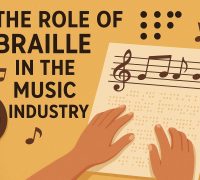
Braille plays a significant role in the music industry by providing accessibility to visually impaired musicians and music enthusiasts. It enables individuals with visual impairments to read and write music independently, ensuring they can participate fully in the musical world. This expansion delves deeper into various aspects of Braille music notation and its significance in fostering inclusivity and equal opportunities.

Understanding Braille Music Notation

Braille music notation is a meticulously developed system tailored for visually impaired musicians, enabling them to read and perform music. Unlike standard music notation, which leverages a visual system—consisting of lines and spaces—to represent pitch and rhythm, Braille music notation adopts a tactile system. This system employs the same six-dot cell used in literary Braille to encapsulate various musical elements such as pitch, rhythm, and dynamics.

The proficiency in Braille music allows musicians to interpret and perform a vast array of musical genres. The unique system offers a comprehensive method to translate the intricacies of musical compositions into a tactile format, which can be read and processed through touch. This tactile approach ensures that musicians with visual impairments are not left out of the loop when it comes to understanding and interpreting complex musical pieces.

The History and Development of Braille in Music

The journey of Braille in the realm of music has a historical depth that traces back to the early 19th century. It was Louis Braille, branded as the ingenious pioneer behind the literary Braille system, who adapted his revolutionary system to encompass music notation. This adaptation marked a transformative chapter in music history for visually impaired individuals.

Louis Braille’s initial design underwent numerous refinements and standardizations over the years. These refinements have enabled a comprehensive method that allows almost any piece of music to be notated in Braille. The enduring legacy of Braille’s innovation is evident in how it laid the cornerstone for accessible music education and professional engagement within the music scene for countless visually impaired individuals.

Modern Advancements

As technology has progressed, it has significantly revolutionized the application and utility of Braille in the music industry. Modern advancements have paved the way for the creation of digital tools that can effortlessly convert standard music notation into the Braille format. This conversion is a milestone in ensuring that musicians with visual impairments are no longer confined to limited choices in musical engagement.

The digital tools not only simplify the learning process for these musicians but also amplify the diversity of music accessible to them. With such technology, learners are empowered to explore a more extensive array of compositions, ranging from classical masterpieces to contemporary hits. This advent of technology serves as a catalyst for broader exploration and learning, making the world of music more inclusive.

The Impact on Education and Professional Opportunities

The impact of Braille music notation extends deeply into the domain of music education. It provides visually impaired students with the necessary tools to learn and engage with music parallel to their sighted counterparts. By accommodating diverse learning needs, Braille music notation ensures that students can explore the expressive and technical aspects of music comprehensively.

Furthermore, the skill of understanding and utilizing Braille music notation opens up a vast landscape of professional opportunities within the music industry. Talented individuals can forge successful paths as performers, composers, and educators. By bridging the accessibility gap, Braille empowers musicians with visual impairments to showcase their talents on professional stages worldwide.

The integration of Braille in education not only fosters inclusion but also promotes diversity within the music community. Schools and educational institutions adopting Braille music notation are nurturing a more inclusive atmosphere where students of all abilities can thrive and express their love for music.

The Role of Organizations in Enhancing Accessibility

Numerous organizations are working tirelessly to enhance the accessibility of music education and career opportunities for visually impaired individuals. They focus on promoting the development of resources and tools that make musical learning seamless for everyone, regardless of visual ability. By advocating for inclusive music education policies and providing support to musicians, these organizations play a pivotal role in ensuring that Braille music notation is effectively integrated into modern music education and performance.

For more information on how Braille music notation is currently being integrated into modern music education and performance, individuals are encouraged to visit organizations dedicated to music accessibility. These organizations serve as vital resources for aspiring musicians and educators looking to broaden inclusive practices in the music industry. Examples of such organizations include Musicians with Disabilities.

Conclusion

In summary, Braille is an essential tool in the music industry, promoting inclusivity and equal opportunities for visually impaired musicians. Its continued refinement and integration into music education and technology ensure that music remains a universally accessible and enriching experience. The evolution of Braille music notation from its inception in the 19th century to its present-day advancements underscores its significance in advancing an inclusive future where everyone can partake in the joy of music.

By building an accessible and inclusive music culture, the industry stands to benefit from the diverse talents and unique perspectives that visually impaired musicians bring to the table. This not only enhances the richness of musical offerings but also fosters a harmonious environment where creativity knows no bounds. As technology continues to evolve, there is hope for even greater collaborations and innovations that further dismantle barriers and pave the way for a vibrant, inclusive musical world.