
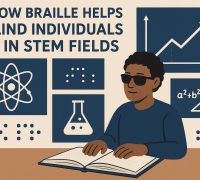
The Role of Braille in STEM Education for the Blind
Braille serves as an indispensable tool for empowering blind individuals, offering them the ability to independently access information. Within the realms of STEM—an acronym for Science, Technology, Engineering, and Mathematics—Braille plays a pivotal role in narrowing the accessibility gap and enabling blind students to fully engage with complex, technical subjects.
Understanding Braille
Braille is a tactile system of reading and writing characterized by raised dots, which symbolize letters, numbers, and punctuation marks. By engaging this system, individuals who are blind gain the capacity to read and write through touch, which forms the basis for autonomous learning and effective communication. Braille is therefore a critical element in the educational process, providing independence and fostering equality in learning opportunities, particularly in STEM subjects.
Accessibility and Independence
In STEM fields, accessibility through Braille opens doors to a wide array of information resources, including textbooks, academic notes, and research papers. Understanding complex concepts and information in STEM disciplines often requires more than auditory learning resources, making Braille an essential tool. Through Braille, blind students can actively participate in a variety of educational activities, reducing their reliance on audio content or assistance from sighted individuals. This independence is crucial for fostering a sense of confidence and proficiency in tackling intricate scientific ideas and methodologies.
Interactive Learning Tools
Technological innovations such as refreshable Braille displays dramatically enhance participation and interaction within STEM education. By converting digital text into Braille, these devices facilitate a dynamic learning experience for blind individuals. These tools connect seamlessly to computers and smartphones, opening up a broad spectrum of digital content. Their real-time interaction capability fosters an inclusive educational atmosphere, allowing blind students to access, read, and comprehend materials simultaneously with their sighted peers. This real-time access is fundamental for active engagement in group discussions, collaborative projects, and comprehensive studies.
Adaptation of Mathematical and Scientific Content
Braille’s adaptation for STEM does not stop with text. It also involves a detailed transcription of mathematical and scientific symbols, which are integral to comprehending subjects such as algebra, chemistry, and physics. The Nemeth Braille Code is a specialized system developed precisely for this purpose, providing a mechanism through which blind students can engage with complex equations, graphs, data presentations, and scientific notation. By utilizing the Nemeth Code, individuals can perform calculations, interpret scientific data, and contribute effectively to technical group projects, ensuring that the blind community can participate on an equal footing with their sighted peers.
Challenges and Innovations
Despite the myriad benefits that Braille provides, challenges persist in the realm of STEM. The process of transcribing detailed scientific content into Braille is complex and often requires educators to undergo specialized training to deliver effective support. Nevertheless, burgeoning innovations continue to mitigate these challenges. Of particular note are tactile graphics, an emergent strategy for conveying visual information such as graphs and diagrams through touchable representations. Tactile graphics play a critical role in subjects like biology, engineering, and geosciences, where visual data interpretation is a core component of the curriculum.
Emerging Technologies
Several forward-thinking organizations are at the forefront of developing state-of-the-art tools designed to fortify Braille’s application in STEM domains. Modern projects, such as creating 3D-printed models and advanced tactile readers, are enhancing the potential for blind students to understand intricate concepts that were previously less accessible. These technological innovations are finding their way into academic curricula, bridging experiential gaps and fostering diverse learning conditions that accommodate all students, irrespective of visual ability. The integration of these tools into educational practice is gradually transforming the educational landscape, making it more inclusive and engaging.
The Future of Braille in STEM
The technological landscape is ever-changing, with continuous enhancements to Braille access and usability on the horizon. Such advancements are crucial for expanding the participation of blind individuals in STEM fields, integral domains for fostering innovation and contributing to economic growth. As learning frameworks evolve to embrace inclusivity, blind professionals stand poised to make substantial contributions across various STEM disciplines. By creating educational environments that celebrate diversity and accessibility, the potential for breakthroughs and innovations by members of the blind community becomes increasingly tangible.
For more information on technological tools that support Braille learning, visit Perkins eLearning.