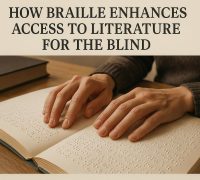
The Role of Braille in Early Education
Early Braille education plays a crucial role in the academic and personal development of blind children. Unlike other learning tools that rely heavily on vision, Braille offers a tactile method of reading and writing that is integral to literacy for visually impaired students. It is not just an alternative method of communication but a foundational skill that empowers blind children in various aspects of their lives.
Historical Context and Development
Invented by Louis Braille in the early 19th century, Braille has evolved into a standardized system used worldwide. Designed to improve accessibility, it enables blind individuals to read and write through a series of raised dots representing letters, numbers, and punctuation. The system’s simplicity and effectiveness have made it indispensable in educational settings. By allowing blind individuals to have direct access to written material, it bridges the communication gap and provides an equal educational foundation.
Importance for Educational Development
Early exposure to Braille profoundly impacts literacy development, mirroring the role print plays for sighted children. Learning Braille at a young age nurtures an understanding of spelling, grammar, and punctuation. These foundational skills are integral to academic achievement, enabling blind students to engage with a broad array of educational resources. Mastery of Braille lays the groundwork for learning complex subjects, as it allows students to access and comprehend educational content independently.
Moreover, Braille education reinforces concepts that are learned auditorily. This includes subjects like mathematics where tactile representations such as graphs and charts can be explored further. The tactile nature of Braille allows blind students to process and understand information effectively, facilitating a comprehensive educational experience. With the integration of Braille in early education, these students are better poised to excel academically, which paves the way for lifelong learning and development.
Enhancing Social and Emotional Growth
Beyond academic prowess, Braille education significantly influences the social and emotional growth of visually impaired children. Mastery of Braille fosters independence and self-reliance, which are indispensable for building personal confidence and enabling social interactions. Literacy skills attained through Braille allow these children to participate more fully in social activities that require reading, writing, or note-taking, facilitating greater social inclusion.
Furthermore, the confidence gained from Braille proficiency can extend to other areas of a child’s life, enhancing their ability to navigate social networks and environments. The feeling of autonomy derived from reading without assistance instills a sense of empowerment, contributing to positive self-esteem and identity formation. Engaging with Braille from an early age prepares children for the complexities of adulthood, ensuring they develop into well-rounded individuals.
Technological Integration and Future Perspectives
In today’s digital age, the integration of technology with Braille education adds another dimension to its significance. Innovations such as Braille displays and electronic notetakers have expanded the accessibility of digital content, making it easier for blind children to engage with a diverse range of materials. Such technologies not only enhance educational experiences but also ensure that visually impaired students remain active participants in the digital world.
These advancements underscore the enduring relevance of Braille in modern education. As technology continues to advance, it promises further enhancements in accessibility and educational outcomes for blind students. By staying abreast of technological developments, educators can incorporate these tools into their teaching methods, optimizing the learning experience for their students. Such integration not only supports traditional learning but also fosters innovative ways of engaging with educational content.
Promoting early Braille education is essential to shape a more inclusive and equitable educational landscape. Access to resources like the Braille Institute and Perkins School for the Blind offers additional support and information for those interested in this field. These institutions provide not only educational materials but also community support, advocacy, and training for educators, caregivers, and students alike.
In conclusion, early Braille education is far more than learning a different form of communication. It represents an essential early step toward lifelong learning and independence for blind children. By committing to Braille education at an early age, society is investing in the future success and well-being of visually impaired individuals, empowering them to reach their full potential and contribute meaningfully to their communities.