
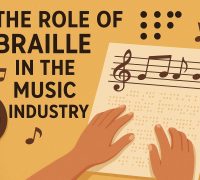
Braille plays a significant role in the music industry by providing accessibility to visually impaired musicians and music enthusiasts. It enables individuals with visual impairments to read and write music independently, ensuring they can participate fully in the musical world. This expansion delves deeper into various aspects of Braille music notation and its significance in fostering inclusivity and equal opportunities.
Understanding Braille Music Notation
Braille music notation is a meticulously developed system tailored for visually impaired musicians, enabling them to read and perform music. Unlike standard music notation, which leverages a visual system—consisting of lines and spaces—to represent pitch and rhythm, Braille music notation adopts a tactile system. This system employs the same six-dot cell used in literary Braille to encapsulate various musical elements such as pitch, rhythm, and dynamics.
The proficiency in Braille music allows musicians to interpret and perform a vast array of musical genres. The unique system offers a comprehensive method to translate the intricacies of musical compositions into a tactile format, which can be read and processed through touch. This tactile approach ensures that musicians with visual impairments are not left out of the loop when it comes to understanding and interpreting complex musical pieces.
The History and Development of Braille in Music
The journey of Braille in the realm of music has a historical depth that traces back to the early 19th century. It was Louis Braille, branded as the ingenious pioneer behind the literary Braille system, who adapted his revolutionary system to encompass music notation. This adaptation marked a transformative chapter in music history for visually impaired individuals.
Louis Braille’s initial design underwent numerous refinements and standardizations over the years. These refinements have enabled a comprehensive method that allows almost any piece of music to be notated in Braille. The enduring legacy of Braille’s innovation is evident in how it laid the cornerstone for accessible music education and professional engagement within the music scene for countless visually impaired individuals.
Modern Advancements
As technology has progressed, it has significantly revolutionized the application and utility of Braille in the music industry. Modern advancements have paved the way for the creation of digital tools that can effortlessly convert standard music notation into the Braille format. This conversion is a milestone in ensuring that musicians with visual impairments are no longer confined to limited choices in musical engagement.
The digital tools not only simplify the learning process for these musicians but also amplify the diversity of music accessible to them. With such technology, learners are empowered to explore a more extensive array of compositions, ranging from classical masterpieces to contemporary hits. This advent of technology serves as a catalyst for broader exploration and learning, making the world of music more inclusive.
The Impact on Education and Professional Opportunities
The impact of Braille music notation extends deeply into the domain of music education. It provides visually impaired students with the necessary tools to learn and engage with music parallel to their sighted counterparts. By accommodating diverse learning needs, Braille music notation ensures that students can explore the expressive and technical aspects of music comprehensively.
Furthermore, the skill of understanding and utilizing Braille music notation opens up a vast landscape of professional opportunities within the music industry. Talented individuals can forge successful paths as performers, composers, and educators. By bridging the accessibility gap, Braille empowers musicians with visual impairments to showcase their talents on professional stages worldwide.
The integration of Braille in education not only fosters inclusion but also promotes diversity within the music community. Schools and educational institutions adopting Braille music notation are nurturing a more inclusive atmosphere where students of all abilities can thrive and express their love for music.
The Role of Organizations in Enhancing Accessibility
Numerous organizations are working tirelessly to enhance the accessibility of music education and career opportunities for visually impaired individuals. They focus on promoting the development of resources and tools that make musical learning seamless for everyone, regardless of visual ability. By advocating for inclusive music education policies and providing support to musicians, these organizations play a pivotal role in ensuring that Braille music notation is effectively integrated into modern music education and performance.
For more information on how Braille music notation is currently being integrated into modern music education and performance, individuals are encouraged to visit organizations dedicated to music accessibility. These organizations serve as vital resources for aspiring musicians and educators looking to broaden inclusive practices in the music industry. Examples of such organizations include Musicians with Disabilities.
Conclusion
In summary, Braille is an essential tool in the music industry, promoting inclusivity and equal opportunities for visually impaired musicians. Its continued refinement and integration into music education and technology ensure that music remains a universally accessible and enriching experience. The evolution of Braille music notation from its inception in the 19th century to its present-day advancements underscores its significance in advancing an inclusive future where everyone can partake in the joy of music.
By building an accessible and inclusive music culture, the industry stands to benefit from the diverse talents and unique perspectives that visually impaired musicians bring to the table. This not only enhances the richness of musical offerings but also fosters a harmonious environment where creativity knows no bounds. As technology continues to evolve, there is hope for even greater collaborations and innovations that further dismantle barriers and pave the way for a vibrant, inclusive musical world.